
Nestled in the heart of the Balearic Islands, Mallorca is renowned not only for its vibrant coastal areas but also for its serene and picturesque countryside. For those seeking a peaceful retreat, the island’s country homes offer a unique blend of natural beauty, privacy, and authenticity. These properties, often set amidst rolling hills and lush farmland, provide a tranquil escape from the busy coastal areas while still offering convenient access to the island’s amenities. Mallorca’s countryside is a haven for those who value sustainable living, traditional architecture, and a connection to nature.
Table of Contents
Mallorca has firmly established itself as one of Europe’s most desirable property markets, but in 2026 the conversation has shifted. The island is no longer an emerging opportunity — it is a mature, high-demand destination where buyers must be more strategic.
For many investors, the key question is no longer whether Mallorca is attractive, but whether it still offers room for growth and long-term value. The answer is yes, but only if you understand how the market has evolved and what now drives it.
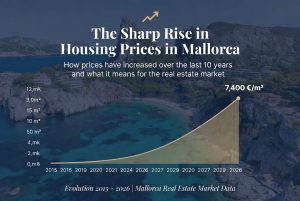
Over the past decade, Mallorca has transitioned from a relatively accessible Mediterranean market into a premium, supply-constrained environment. Prices have risen steadily, particularly in prime areas, but what is more important is how they have risen.
Unlike markets driven by rapid speculation, Mallorca’s growth has been underpinned by structural demand. Even during periods of economic uncertainty, property values have remained stable or continued to increase at moderate rates.
By 2026, this trend has become even more evident. Annual price growth has stabilised, typically ranging between three and five percent, with stronger performance in highly sought-after locations. This slower pace is often misunderstood as a sign of weakening demand, when in reality it reflects a healthier and more sustainable market.
For investors, this type of environment offers something increasingly rare: predictability.
One of the most important factors supporting Mallorca’s property market is its international buyer base. Unlike many regions in Spain, demand here is not primarily driven by local purchasers, but by a diverse mix of foreign investors and second-home buyers.
German, Scandinavian and British buyers have traditionally dominated the market, but in recent years there has been a noticeable increase in interest from the United States and other international markets.
What makes this demand particularly strong is that it is not purely financial. Buyers are not simply looking for returns — they are looking for lifestyle, security and long-term usability. Many intend to use the property themselves, either seasonally or permanently.
This creates a much more resilient market, less vulnerable to short-term economic fluctuations.
If there is one element that truly defines Mallorca as an investment destination, it is the limited availability of land.
The island operates under strict planning regulations, particularly in rural and coastal areas. Large portions of land are protected, and new development is tightly controlled. While this can be frustrating from a development perspective, it is precisely what protects long-term value.
In simple terms, demand continues to grow, but supply cannot expand at the same rate.
This imbalance is not temporary. It is structural, and it is one of the main reasons why property in Mallorca has proven to be such a strong long-term asset.
A common mistake among investors is to view Mallorca as a single market. In reality, it is made up of multiple micro-markets, each with its own dynamics.
Prime areas such as the southwest, Palma and parts of the north consistently outperform the rest of the island. These locations benefit from a combination of accessibility, infrastructure and international demand.
In contrast, secondary areas may offer lower entry prices but often lack the same level of liquidity and long-term appreciation.
For this reason, choosing the right location is often more important than choosing the right property.
Rental demand in Mallorca remains strong, particularly for long-term rentals in urban areas such as Palma and established residential zones.
However, the regulatory environment has changed significantly in recent years. Short-term holiday rentals are now heavily restricted, and obtaining licences can be complex or, in some areas, impossible.
This has shifted the investment landscape. While short-term rental strategies can still be viable in specific cases, long-term rentals often provide a more stable and predictable return.
Investors need to approach this segment with a clear understanding of the legal framework, rather than relying on outdated assumptions.
What truly differentiates Mallorca from many other property markets is the role that lifestyle plays in sustaining demand. The island offers a combination of climate, safety, accessibility and natural beauty that is difficult to replicate elsewhere in Europe. This creates a type of demand that goes beyond purely financial considerations.
Even when yields fluctuate or growth slows, the intrinsic value of living in Mallorca remains high. This is why the market continues to attract buyers even at elevated price levels.
In many ways, Mallorca should not be viewed as a traditional investment market, but as a hybrid between lifestyle and capital preservation.
No investment is without risk, and Mallorca is no exception.
The most significant factor to monitor is regulation. There is increasing political pressure in the Balearic Islands to address housing affordability, which could lead to changes affecting foreign buyers or taxation.
Additionally, the high entry price of the market means that margins for error are smaller. Buying the wrong property or overpaying in a secondary location can limit future returns.
There are also indications that certain segments, particularly new-build luxury developments, may be approaching saturation in specific areas. This does not affect the entire market, but it reinforces the importance of careful selection.
Mallorca is no longer a market where quick gains are easily achieved. It does not reward speculation or short-term strategies.
However, for investors who prioritise long-term stability, capital preservation and consistent demand, it remains one of the strongest property markets in Europe.
The key is to adjust expectations.
This is not about finding undervalued assets in a rising market. It is about securing a position in a market that is already established and likely to remain in demand.
Ultimately, investing in Mallorca is less about timing the market and more about understanding it.
The island offers a rare combination of limited supply, international demand and lifestyle appeal. These factors create a level of stability that is increasingly difficult to find elsewhere.
For those willing to take a long-term view, Mallorca continues to represent not just a good investment, but a strategic one.
At Balearic Properties, we work with buyers who are looking beyond short-term opportunities and focusing on long-term value.
Whether the goal is a second home, a relocation or a carefully selected investment, understanding the nuances of the market is essential.
Because in Mallorca, the best decisions are rarely the most obvious ones.
Call now, send us a message on WhatsApp, or fill out the contact form, and we’ll get back to you as soon as possible.